

Your care. Your voice. Your province.
When health professionals are afraid to speak, patients hear less.
Bill 36—now the Health Professions and Occupations Act—changed how regulated health professionals in British Columbia are governed. The concern is that its complaint, discipline and oversight system may constrain professional judgment, create a climate of fear and make B.C. a harder place to practise—with consequences for the people who rely on their care.
A better way forward
Better healthcare starts with working together.
A better healthcare system should be built with the people who deliver care and the people who depend on it.
Doctors, nurses and other healthcare professionals need a meaningful voice in decisions that affect their work. Patients and families deserve to be part of that conversation too.
BC Health Voices opposes Bill 36 and calls for government to work with these groups to shape a better way forward. When you or someone you love needs help, you want everyone working together for you.
What this can mean for you
Good care depends on more than an appointment.
It also depends on whether health professionals can speak candidly, use their experience and choose to keep practising in British Columbia.

01
Will your health professional feel free to be candid?
Patients need honest advocacy and professional judgment—even when the safest advice is difficult or challenges a policy.

02
Will familiar care still be there?
Recruitment, retirement and relocation decisions across healthcare professions can determine whether families retain access and continuity.

03
What happens where care is already scarce?
Smaller and rural communities can feel the loss of even one healthcare professional deeply.
See how the concern can travel from regulation to patient care →
The change, visually
Bill 36 changed who holds power over health-profession regulation.
The former elected-board model is gone. Regulatory college boards are now fully appointed by the Minister of Health, and half of their members are public representatives. Many health professionals see this as a loss of professional self-governance and a shift toward decision-makers without clinical experience having greater influence over regulation.
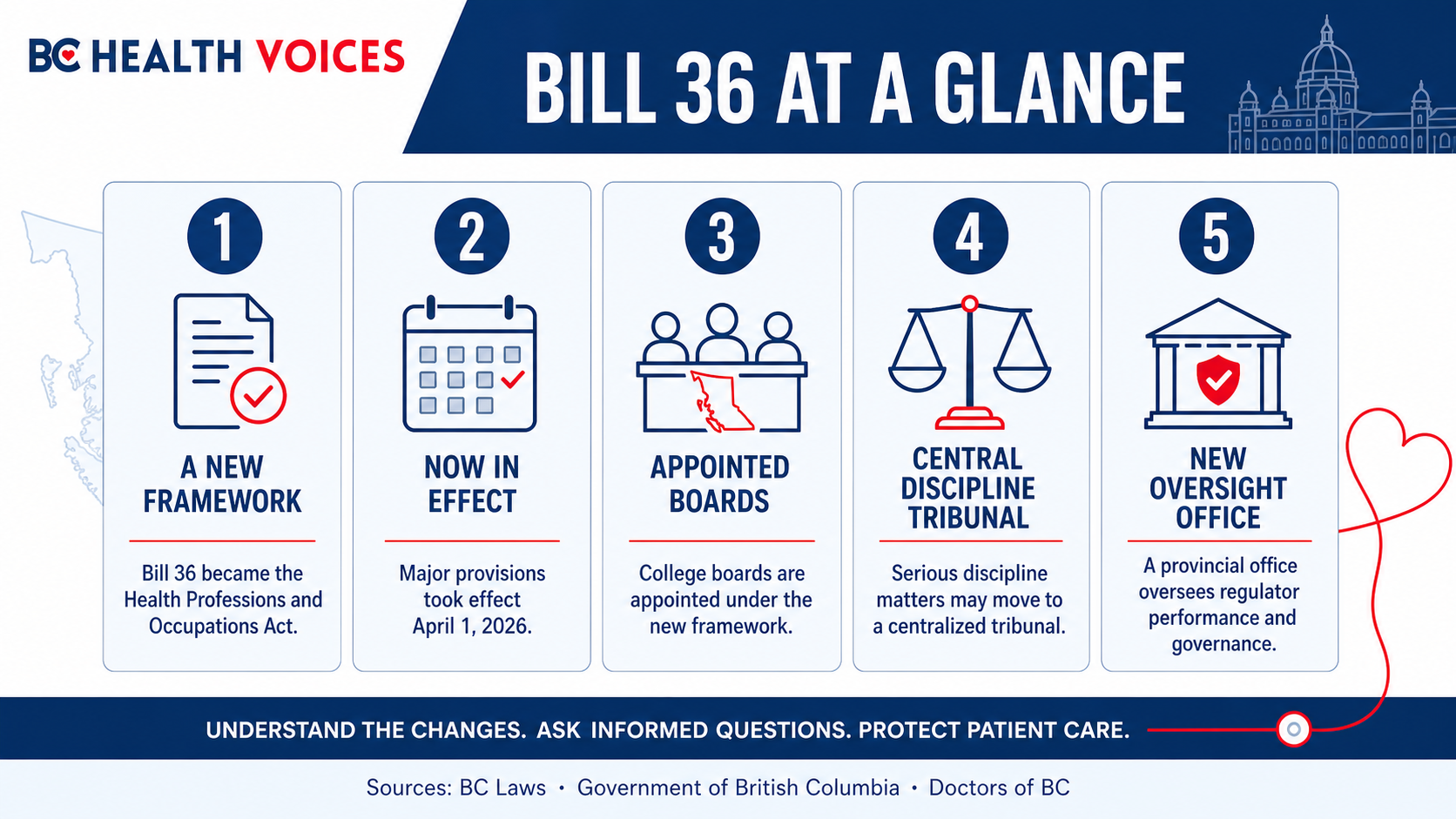
Select the graphic to view it full size

This belongs to all of us
Healthcare policy becomes real in our homes and communities.
The campaign exists so British Columbians can understand Bill 36, hear the concerns being raised across healthcare and stand up for care that remains candid, accessible and centred on patients.